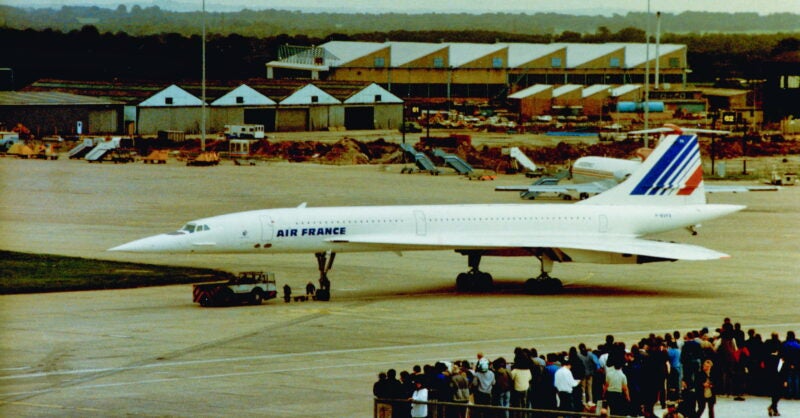
On February 7, 1996, British Airways Concorde G-BOAD made a stunning arrival at Heathrow Airport in light snow and mist, completing a flight from JFK airport in New York in just two hours, 52 minutes, and 59 seconds. Even decades later, the record for the fastest civilian flight across the Atlantic remains intact. Traveling on Concorde was about more than speed; it was an experience marked by encounters with celebrities and an allure that only a supersonic aircraft could offer.
Renowned figures such as David Frost, Elton John, and Elizabeth Taylor frequently traversed the Atlantic on Concorde, elevating its status to one of the most exclusive travel experiences. Notably, in 1985, Phil Collins famously used Concorde to perform at Live Aid in London before flying to Philadelphia to join Eric Clapton. Victoria Beckham and Robbie Williams also took advantage of the aircraft’s speed for last-minute dress fittings and award collections. Additionally, tales of the Queen Mother commandeering the controls during a test flight persist, though such claims remain unconfirmed.
Among the 20 Concordes constructed from 1966 to 1979, only 14 served commercial flight. Seven were operated by British Airways and seven by Air France. The cabin, although intimate and accommodating just 100 passengers, offered an experience that rivaled first-class service in luxury. Gourmet options such as fillet steak, lobster, and caviar canapés were often featured on the menu, and collectible items like postcards, luggage tags, and in-flight magazines now fetch substantial prices at auctions and online.
On April 9, 1969, Sir James Dyson found himself observing the inaugural test flight of Concorde from the M4 motorway in Bristol. “I pulled over to watch it fly overhead,” he recounted, noting the altimeter failure during the flight as relayed by test pilot Brian Trubshaw. Dyson experienced three Concorde flights, even visiting the flight deck during one landing. He now showcases a genuine Concorde Rolls-Royce Olympus 593 turbojet engine at his campus in Malmesbury, with comparable models selling for approximately £450,000 (around $605,200).

Though it enjoyed a glamorous history, Concorde’s operational lifespan ended in 2003. The tragic Air France Flight 4590 accident in July 2000 accelerated its decline, compounded by rising maintenance costs and a significant drop in premium travel following the events of September 11. The abrupt end of Concorde’s service was a stark reminder of how quickly aerospace advancements can regress, leading collectors to seek out various memorabilia associated with the plane.
The market for Concorde memorabilia ranges widely, including items like cabin dishware, signage, and salvaged components, some of which command prices in the hundreds of thousands. The highest sale occurred in December 2003, when a captain’s seat fetched £30,550 (around $41,000) at a Bonhams charity auction, while other items such as a cabin trolley sold for £6,462 (about $8,690).
Concorde memorabilia
The entry point: Tableware and on-board ephemera
Concorde’s in-flight dining service included Royal Doulton and Wedgwood bone china, alongside Arthur Price cutlery, much of which was redesigned by Sir Terence Conran during the final refit in 1999. These items present a manageable way for collectors to enter the market, with menus starting around £15 (approximately $20) on eBay. A complete place setting recently sold for £150 (about $200).

Visitors to the Brooklands restaurant at The Peninsula London can find steel napkin clips engraved with “honourably pinched from The Peninsula London,” a humorous nod to the spoils taken by eager passengers. One single teaspoon designed by Conran is currently listed for £21 ($28). Tableware remains one of the most abundant categories of Concorde memorabilia, ensuring a steady supply for collectors.
The mid-market: Models and watches
Scale models represent a highly sought-after segment of Concorde memorabilia for enthusiasts. Tim Bent, the founder of Bentleys antique shop, notes the emotional connection such models foster, often reminding buyers of their memories associated with Concorde. The finest models were produced under contract by Space Models and Westway Models for British Airways’ corporate offices and travel agents. Mint-condition models start at around £495 (about $665) and can exceed £10,000 (about $13,450) based on size and provenance.

In terms of watches, the Breitling Aerospace Concorde stands out among collectors. Developed in the late 1990s, only 100 pieces were created under a deal brokered by Jock Lowe, a former Concorde pilot. Instances of these limited watches reaching the market are rare, with one selling for £5,000 (around $6,725) at auction in 2023. Additionally, Bremont’s Supersonic watch, released in 2018 with metal sourced from G-BOAB Concorde, is available, with a Rose Gold variant priced at £12,536 (approximately $16,860).
The blue-chip pieces: Instruments and components
The highest tier of Concorde collectibles includes actual pieces from the aircraft, exemplified by a Concorde nose cone auctioned in 2018 for £63,000 (about $84,700), which now serves as a centerpiece in The Peninsula London’s lobby. A 48-foot-long alloy “speedform” sculpture also hangs in the hotel’s Brooklands by Claude Bosi restaurant.

In the realm of memorabilia, the record was set at the 2003 Bonhams auction, where a nose cone sold for £320,000 (approximately $430,400). Currently, there are no complete aircraft available for sale, as the remaining 18 Concordes are preserved in museums and collections around the globe. As the Concorde’s legacy continues to captivate enthusiasts, its collectible components offer a finite yet highly desirable market, with values that are expected to rise.